
A scroll story · How the northern lights get here
From the Sun to Tromsø

On the evening of 10 October 2024, strong northern lights were seen across large parts of Norway – and as far south as Italy and Spain. They were set off by a cloud from the Sun that crossed 150 million kilometres in 37 hours. This is how it got here.
By Pelle Nilsen · 16 October 2026 · 56 sources · How this page was made
The real thing: region 3848 flares near the middle of the Sun’s face early on 9 October 2024, in NASA’s Solar Dynamics Observatory footage in extreme ultraviolet light (304 Å), sped up. Film: NASA’s Scientific Visualization Studio.
Wednesday 9 October 2024 · 03:56 in Norway
It starts with a flash on the Sun
A tangle of sunspots called region 3848, close to the middle of the Sun’s face, lets go of a strong X1.8 flare. Seen from Earth, it peaks at 01:56 UTC – its light has taken about 8 minutes 20 seconds to get here.
But the flash is not what will light up the sky over Norway. Half an hour later, a coronagraph on the SOHO spacecraft sees a cloud spreading out all round the Sun: a coronal mass ejection, magnetised gas – often a billion tonnes or more – flung off towards us. By the afternoon, America’s space weather forecasters have issued their second-highest storm watch, G4, for the next day.
- 109 ×as wide as the Earth
- 5,500 °Cat its surface
- 2 million °Cat most, in its thin outer atmosphere, the corona
Wednesday 9 – Thursday 10 October 2024
37 hours across 150 million kilometres
Follow the cloud sideways from the Sun to the Earth, drawn to scale: the Sun is the size of a coin here, and the Earth, smaller than a pixel at this scale, is marked with a dot. The clock runs at the cloud’s average speed – about 1,100 kilometres a second, nearly three times the ordinary solar wind. Times are Norwegian.
Swipe the row, or use ← and →, to travel from the Sun to the Earth.
The drawing, in words: the Sun at one end, 1.4 million km across; the Earth at the other, 150 million km away, with the Moon’s orbit around it. Times along the way, in Norwegian time at the cloud’s average speed: Wednesday 06:00 about 8 million km out, Wednesday 12:00 about 32 million, Wednesday 18:00 about 56 million, Thursday 00:00 about 80 million, Thursday 06:00 about 104 million, Thursday 12:00 about 129 million; Thursday 16:48 the cloud passes the solar-wind monitors 1.5 million km from Earth, and at 17:15 it reaches the Earth.
Arrival: how the cloud becomes light
Thursday 10 October · 17:15 in Norway
The cloud hits Earth’s magnetic shield
Facing the Sun, Earth’s magnetic field normally holds the solar wind off about 10 Earth radii out – roughly 65,000 km. At 17:15 the cloud’s shock wave slams into it, and magnetometers on the ground jump – in the US from 17:15, in Britain from 17:22: the storm has begun.
The night side
The tail snaps back
The solar wind doesn’t simply pour in. It stretches Earth’s field on the night side into a tail hundreds of Earth radii long, like a rubber band. When the stretched field lines snap and reconnect, electrons from inside the magnetic field – mostly not ones straight from the Sun – are fired down along the field lines towards the poles.
The auroral oval
They come down in a ring
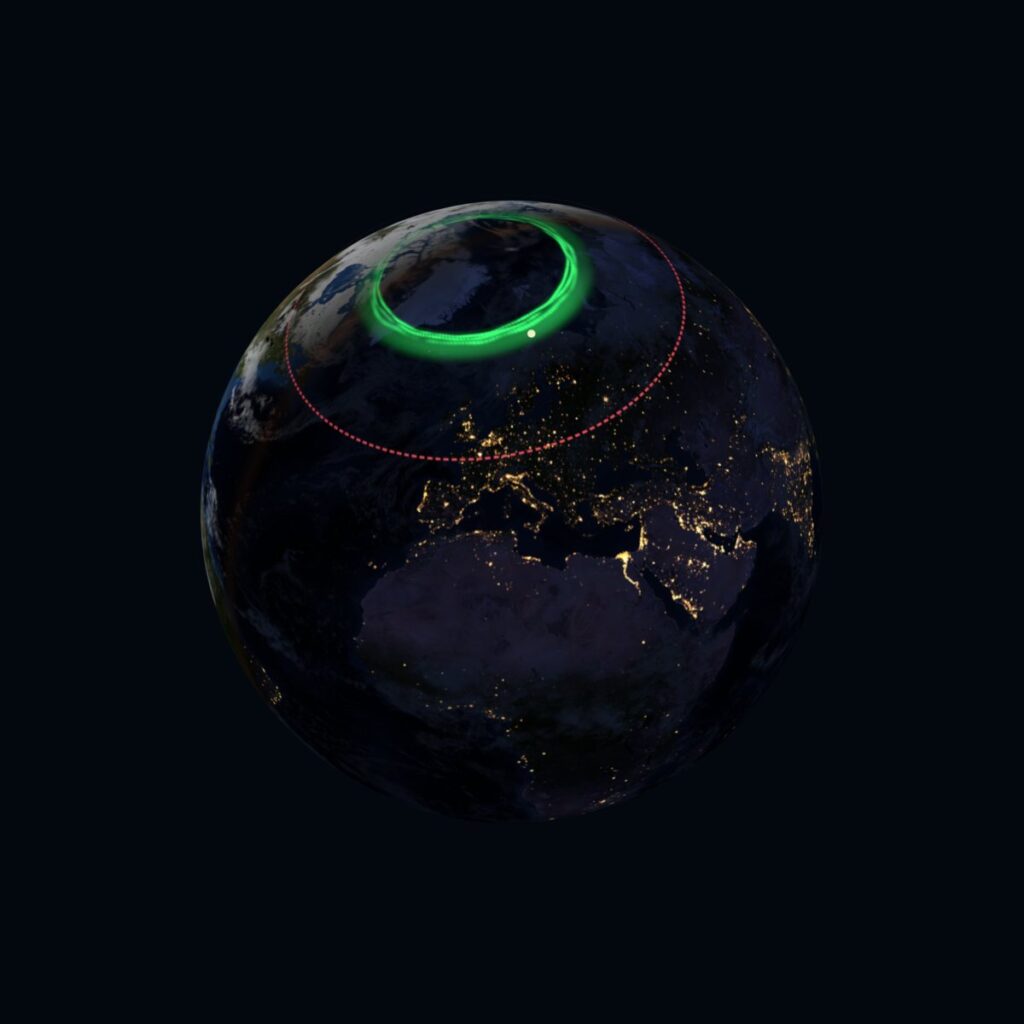
The electrons rain down in a ring around the magnetic pole: the auroral oval. On a quiet night its night side lies along the coast of Troms and Finnmark – and Tromsø, at 66.7° magnetic latitude, sits under it.
The green ring on the globe is drawn for a quiet night, at 23:00 Norwegian time. On 10 October it didn’t stay there: every step up the 0–9 Kp scale pushes its edge about 2° further south, and that night the storm reached Kp 9−. The dashed red line shows roughly where that rule of thumb puts the edge at the peak – across the North Sea and the Baltic.
Into the sky · drawn to scale
From 460 km up to the streets of Tromsø
Fall with the electrons. From here to the ground, the page is drawn to scale: every kilometre is 9 pixels on a computer, so the curtain of light, the edge of space and the Space Station sit at their real heights.
The fall through the sky: from 460 km to the ground

20,000 km/s The electrons arrive
Fired down along the magnetic field, the electrons hit the thin upper air at about 20,000 km a second – a tenth of the speed of light. Each one that hits an atom hands it energy, and the atom gives it back as light.
400 km The Space Station
The International Space Station orbits about 400 km up. Its crew looks down on most of the aurora. The red tops of a curtain can reach several hundred kilometres; it is rarely seen above 500 km.
Above 200 km Red: oxygen, high up
The red is oxygen too – but the atom has to go a minute or more without being bumped by a neighbour before it can glow red. Only up here is the air thin enough for that. On the evening of 10 October, NRK reported strong red northern lights over large parts of Norway.
115 km Green: oxygen, 0.7 seconds
The commonest colour. Oxygen atoms about 100–150 km up wait about 0.7 seconds, then glow green, strongest at around 115 km. Below about 95 km the air is so dense that the atoms are bumped before the green can come out.
100 km The edge of space
The Kármán line – the edge of space as the FAI set it in 1960, at 100 km – runs just above the curtain’s bright lower edge, at about 90–100 km. On his 1913 expedition Carl Størmer photographed the same aurora from two places at once and measured its height against the stars: most aurora is brightest about 100 km up. Along the very bottom, when the electrons are especially energetic, nitrogen can add a pink or purple fringe.
421 m The ground: Tromsø
The upper station of Fjellheisen, Tromsø’s cable car, stands 421 metres above the sea. At this scale it is less than 4 pixels tall. The green glow above it is about 270 times higher – and more than ten times higher than the airliners, which cruise at about 10 km.
Thursday 10 October 2024
That evening in Norway
From the flash on the Sun to the peak over Norway took less than two days. In Norwegian time:
- The X1.8 flare peaks on the Sun.
- A coronagraph on the SOHO spacecraft sees the cloud spreading out all round the Sun.
- America’s Space Weather Prediction Center issues a G4 (severe) storm watch, expecting the cloud at 1,200–1,300 km/s.
- The cloud passes the solar-wind monitors 1.5 million km out. The wind speeds up from about 400 to as much as 815 km/s.
- The storm begins: magnetometers on the ground jump.
- The Sun sets in Tromsø. By about 21:00 the sky is fully dark.
- Kp 8+: a severe storm.
- The peak: Kp 9−, one step from the top of the scale. That evening and night NRK reported strong red northern lights over large parts of the country, and aurora was seen as far south as Italy and Spain.
Five months earlier
The bigger storm the Arctic missed
On 10–11 May 2024, a giant sunspot group sixteen times wider than the Earth sent a string of clouds our way. The storm hit the very top of the scale – Kp 9, “extreme”, the first in more than 20 years – and squeezed Earth’s magnetic shield to half its normal size, inside the orbit of geostationary satellites. The northern lights were seen by eye as far south as central Mexico and India.
But in Tromsø it never got dark. A week before the midnight sun, the Sun dipped no more than 2.7° below the horizon, and the sky stayed in twilight all night. At the peak, the oval had slid far to the south. The show belonged to southern Norway and Europe.
Seeing it yourself
When can you see the northern lights in Tromsø?
Geomagnetic activity also tends to rise around the equinoxes, in March and September, when the tilt of Earth’s field makes it easier for the solar wind to couple in – so late September and October are often lively months.
The short answers
The northern lights in four numbers
How long things take to get here from the Sun
How we know
Norway’s northern lights scientists
1896. The physicist Kristian Birkeland proposes that the aurora is caused by charged particles from the Sun, guided by Earth’s magnetic field. Later, in his lab, he fired electron beams at a magnetised ball – a little Earth, the “terrella” – and made rings of light round its poles. Satellites confirmed his electric currents along the field lines in the late 1960s; today they are called Birkeland currents, and he is on the 200-krone note issued in 1994.
1899. Birkeland’s team spends the winter on the 900-metre summit of Haldde near Alta. A permanent observatory follows there in 1912.
1913. Carl Størmer photographs the same aurora from two places at once and triangulates its height against the stars: most aurora is brightest about 100 km up, still the accepted answer.
1928. The Northern Lights Observatory opens in Tromsø, paid for by the Rockefeller Foundation. It became part of the University of Tromsø in 1972.
Questions about the northern lights
What causes the northern lights?
Electrons hitting the upper atmosphere, mostly 90–130 km up, where they make oxygen and nitrogen glow. The energy comes from the Sun: the solar wind, and clouds of gas the Sun throws off, stretch Earth’s magnetic field on the night side. When the stretched field snaps back, electrons from inside the magnetic field are fired down along the field lines towards the poles. For the most part, it isn’t particles straight from the Sun that make the light.
How long does it take for a solar storm to reach Earth?
Usually one to four days. The cloud in this story set off from the Sun around 03:56 Norwegian time on 9 October 2024, when the flare peaked, and hit Earth at 17:15 the next day – about 37 hours, at an average of about 1,100 km a second. The fastest on record, in August 1972, took 14.6 hours. The flash of light from a flare arrives in about 8 minutes 20 seconds.
How high up are the northern lights?
Mostly 90–130 km up. The bright lower edge of a curtain is about 100 km up, the green is strongest around 115 km, and the red can reach several hundred kilometres. The International Space Station, at about 400 km, flies above most of it.
Why are the northern lights green?
Most of the light comes from oxygen atoms about 100–150 km up. An oxygen atom hit by an electron waits about 0.7 seconds and then gives off green light, at 557.7 nanometres.
Why are some northern lights red?
Red comes from oxygen too, but higher up, above about 200 km. The atom has to wait a minute or more before it can glow red, and only where the air is thin can it wait that long without being bumped by a neighbour. A pink or purple fringe along the bottom of a curtain comes from nitrogen.
Why does Tromsø see so much aurora?
Because it lies under the auroral oval, the ring around the magnetic pole where the aurora is most common. On a quiet night the oval’s night side runs along the coast of Troms and Finnmark, and Tromsø is at 66.7° magnetic latitude. It can see aurora on about every other clear night, even when the Sun is calm.
When is the northern lights season in Tromsø?
From early September to mid-April. The rest of the year the sky is too light. The best time is usually between 20:00 and 02:00; the strongest displays often come within an hour or two of midnight.
What is the Kp index?
A measure of how disturbed Earth’s magnetic field is, on a scale from 0 to 9, worked out for every three hours from 13 magnetic observatories around the world. Tromsø can see aurora at Kp 0–1. Each step up moves the oval’s edge about 2° further south, so southern Norway and most of Europe only see it in strong storms.
Was the May 2024 storm seen in Tromsø?
We found no report of it. On 10–11 May 2024 the Sun in Tromsø dipped no more than 2.7° below the horizon, so the sky stayed in twilight all night, and at the peak the auroral oval had moved far to the south. The storm was the strongest in more than 20 years, and was seen across southern Norway, in Europe, and as far south as Mexico and India.
Is the solar maximum over?
The Sun’s 11-year cycle peaked in October 2024, with a smoothed sunspot number of about 161, and is slowly calming. Big storms still come: November 2025 and January 2026 both reached Kp 9−. Strong aurora is still likely in the coming winters, though not as often as at the peak.
Why does my phone show colours I can’t see?
In the dark we see with rod cells, which are sensitive but see no colour, so faint aurora often looks grey to the eye. A phone collects light for seconds and processes it, and shows the green, red and pink that are really there.
Can you see the northern lights in summer?
Not in Tromsø: from mid-April to early September the sky is too light, and in 2024 the Sun didn’t set at all from the night of 16–17 May to the night of 25–26 July. The aurora is still there – it happens nearly all the time – but it is drowned out by daylight.
Sources
Researched and checked on 15–16 October 2026, from 56 sources; the main ones are below. Where sources disagree – the times of the storm, its strength, how high red aurora begins – we use the measured values from the primary data and research, and say so. Calculations (such as 37 hours, 1,100 km a second or 11,700 Earths) are ours.
- NOAA Space Weather Prediction Center: Space Weather Highlights 7–13 October 2024 (PRF 2563); G4 storm watch for 10–11 October; G4 levels continue to be observed
- STCE, Royal Observatory of Belgium: “X1.8 flare and earth-directed CME” (9–11 October 2024); USGS: “Severe magnetic storm ongoing”; British Geological Survey: space weather update, 11 October 2024
- NASA’s Scientific Visualization Studio: “An X1.8 flare from Active Region 13848 – October 9, 2024” (the film of the Sun, from NASA’s Solar Dynamics Observatory)
- GFZ Potsdam: the geomagnetic Kp index since 1932 (data file read in full); WDC for Geomagnetism, Kyoto: provisional Dst, October 2024
- NRK Nordland: “Flere kraftige solstormer gir nordlys” (9–11 October 2024); NRK: “Kraftigste nordlyset på mange år” (11 May 2024)
- MET Norway: Sunrise API (sun times for Tromsø, 2024 and 2026–27)
- Hayakawa and others (2024): “The Solar and Geomagnetic Storms in May 2024: A Flash Data Report”, The Astrophysical Journal; Grandin and others (2024): “The Gannon Storm: citizen science observations”, Geoscience Communication 7
- NOAA SWPC: Solar Wind, Coronal Mass Ejections, Solar Flares, Aurora, Aurora Tutorial, Tips on Viewing the Aurora and the NOAA Space Weather Scales
- Tsurutani and others (2024): “Review of the August 1972 and March 1989 (Allen) Space Weather Events”, JGR Space Physics
- NASA: Sun Fact Sheet, Earth Fact Sheet, Moon Fact Sheet, “Sun: Facts” and the International Space Station; IAU: the astronomical unit (Resolution B2, 2012)
- NASA (D. P. Stern and M. Peredo): “The Magnetopause”; NASA: “Earth’s Magnetosphere”; UC Berkeley: “THEMIS mission identifies power behind northern lights”
- Store norske leksikon: “nordlys”, “Kristian Birkeland”, “Carl Størmer” and “Nordlysobservatoriet i Tromsø”
- Tromsø Geophysical Observatory, UiT (T. L. Hansen): “The Northern Lights – where, when and what”; UiT: “How can I see the Northern Lights?”; ISEE, Nagoya University: EISCAT map and coordinates
- Whiter and others (2023): “The altitude of green OI 557.7 nm and blue N2+ 427.8 nm aurora”, Annales Geophysicae 41; D. Lummerzheim: “The Colors of the Aurora”, Alaska Park Science
- FAI (N. Bérend): the Kármán line definition; Fjellheisen: fjellheisen.no
- Brekke (2021): “The legacy of the Haldde Observatory”, History of Geo- and Space Sciences 12
- SIDC/SILSO, Royal Observatory of Belgium: “Solar Cycle 25 reached its maximum in October 2024”; NASA and NOAA: “Sun Reaches Maximum Phase in 11-Year Solar Cycle”; Lockwood and others (2020): semi-annual variations in geomagnetic activity, J. Space Weather Space Clim. 10
- The Conversation (D. Goodwin): why phones see the northern lights better than the eye
- NASA Visible Earth: Blue Marble Next Generation (May), Black Marble 2016 and Blue Marble clouds (the maps on the globe)
Numbers we left out
- “The northern lights are particles from the Sun hitting the atmosphere” – a simplification. NOAA says plainly that it is not the solar wind’s electrons that make the aurora; they come from inside Earth’s magnetic field.
- Seen in Tromsø on 10 October 2024 – not confirmed: we found no report naming the city that night, and no record of its weather. NRK reports strong red aurora over large parts of the country, with a photo from Sortland, about 175 km south-west. A widely shared Tromsø photo from that week was taken on Monday 7 October.
- “G4 at 12:37 EDT” and “the storm began at 12:06 ET” (May 2024) – times in American agency posts that fall before the measured shock at 17:05 UTC (19:05 in Norway); we use the measured time.
- Blue aurora “at 80–100 km” – a large study finds blue and green at about the same height, around 115 km. A pink or purple fringe at the bottom only shows when the electrons are especially energetic.
- Red aurora “only above 300 km” – most sources put it from about 200 km up; it has no sharp floor.
- A magnetic tail “1,000 Earth radii long” – NASA says “possibly”, and that its exact length is not known.
- Haldde, “the world’s first northern lights observatory” (1899) – Alta Museum’s claim. The observatory’s historian describes 1899–1900 as a winter expedition; the permanent observatory came in 1912.
- Birkeland’s theory “in 1886” – in Store norske leksikon’s article on the aurora; its own article on Birkeland says 1896.
- Polar night “27 November – 15 January” – the usual dates. For 2026–27, MET Norway gives no sunrise from 28 November to 14 January.
- The Kp you need in Oslo – sources give anything from 3 to 5; we say “only in strong storms”.
- Sámi beliefs about whistling or waving at the aurora – we found them only on travel sites, so we left them out.
About the author. Pelle Nilsen, a developer in Norway and the maker of Midground, researched this story from 56 sources – NOAA, NASA, Norwegian research institutes, peer-reviewed papers and the raw Kp data – and checked every figure on 15–16 October 2026.
Share it: midgroundwp.com/northern-lights · Cite it: Nilsen, P. (2026). “From the Sun to Tromsø: how the northern lights get here.” Midground. https://midgroundwp.com/northern-lights/
Spotted a mistake? Write to hello@midgroundwp.com and we’ll fix it.
Behind the page
How we made this page
This story is an ordinary WordPress page, built in Midground, a WordPress theme and visual builder for pages that move. The words, cards, questions and scroll effects are the builder’s own blocks; the drawings, the chart, a stylesheet for the page and a short script are our own code.
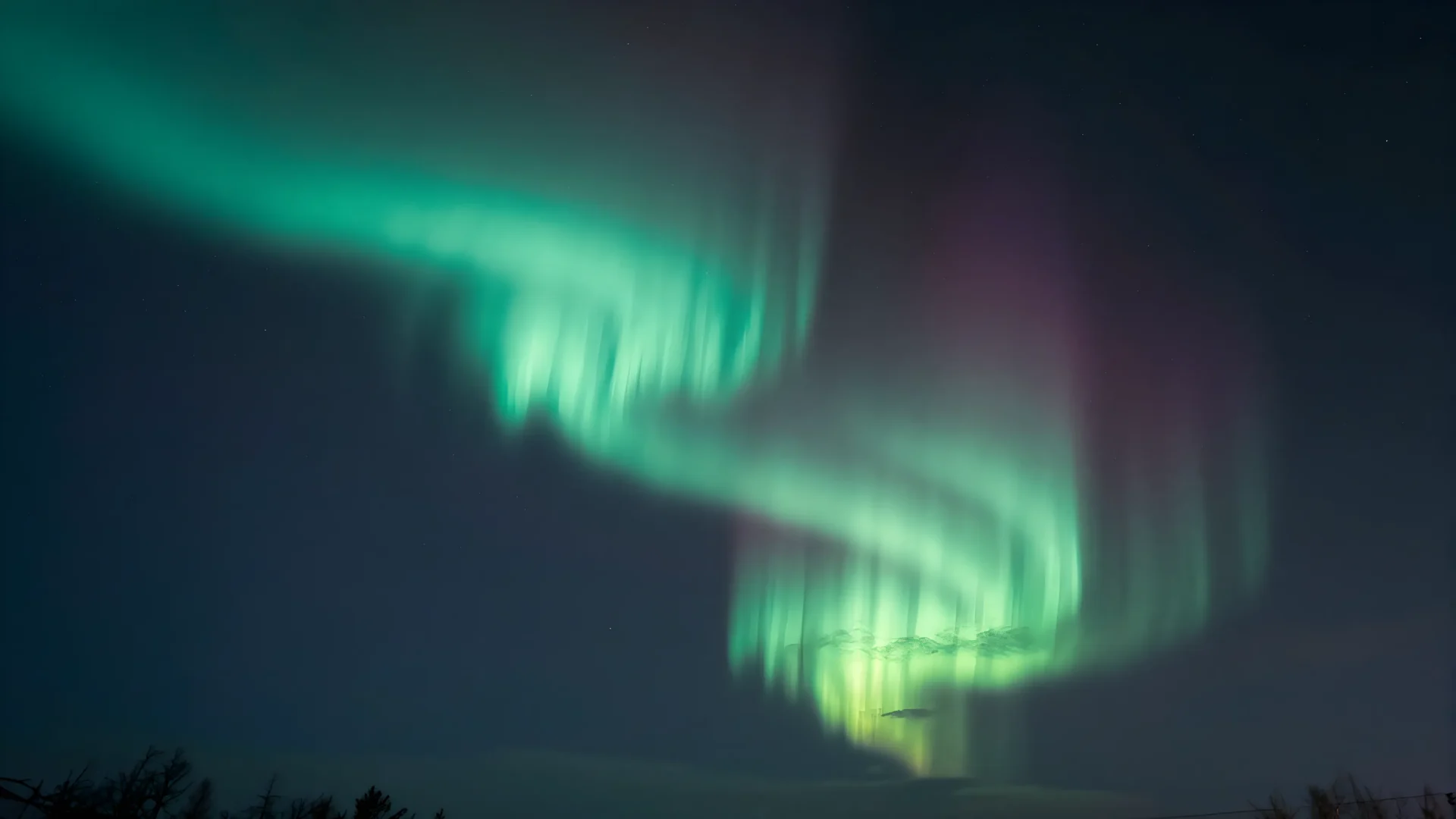
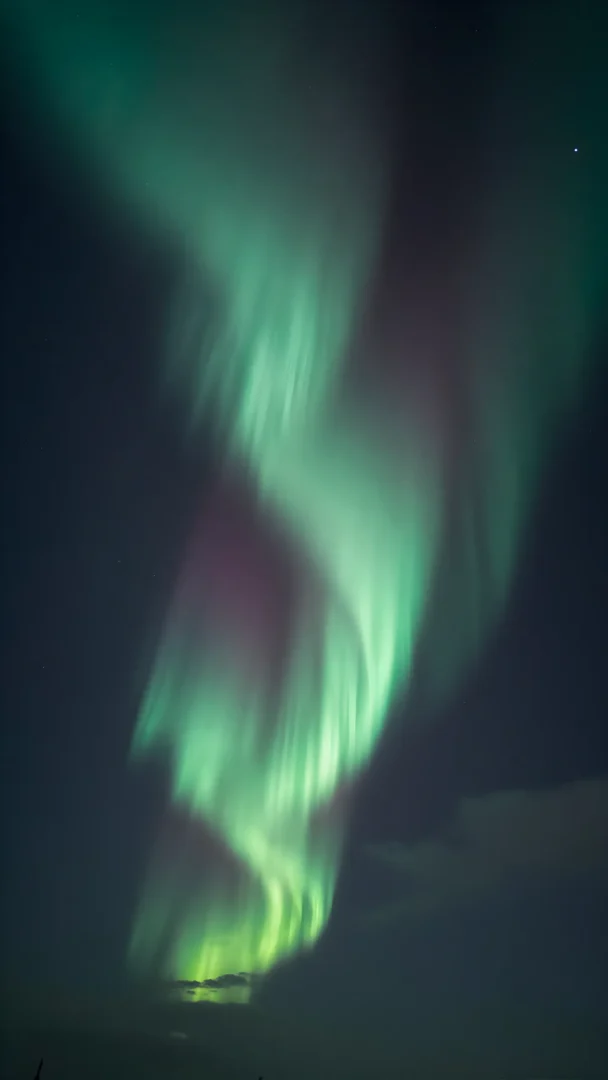
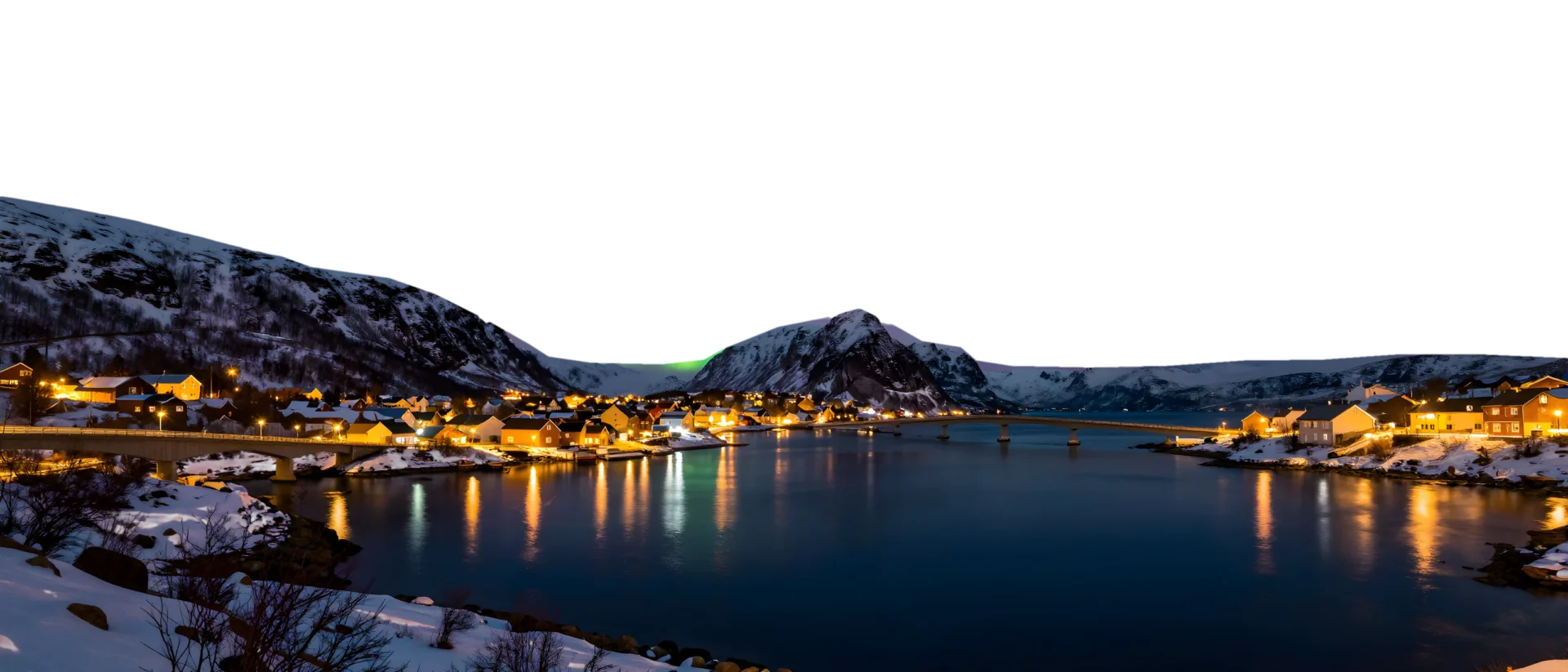
- The opening picture is an illustration, not a photo of Tromsø. We made the sky, the town and the photographer with AI image models, set the sky moving with an AI video model, cut them out, and put them in a Depth group so they move at different depths as you scroll.
- The Sun is real: NASA’s footage of the flare of 9 October 2024, from the Solar Dynamics Observatory.
- The crossing is a Horizontal sequence with a 9,000-pixel drawing on a computer: the Sun and the Moon’s orbit are at the same scale as the distance, and the Earth, less than a pixel at that scale, is marked with a dot. The clock, which runs at the cloud’s average speed, is part of our short script.
- The globe is a 3D model we made in Blender from NASA’s Blue Marble, Black Marble and cloud maps, with day and night baked in for 21:00 UTC on 10 October 2024. It turns as you scroll and only loads when you get close; the green ring is drawn from a simple model of the oval on a quiet night, and the dashed red line from NOAA’s rule of thumb of about 2° per step on the Kp scale.
- The sky is a section exactly 460 km tall – 9 pixels a kilometre on a computer, 8 on a tablet, 6.5 on a phone. The curtain of light is a volumetric render from Blender, with its colours at roughly the heights the research gives.
- If you ask your device for less motion, the layers stay still, the films don’t play, and the crossing becomes a row you swipe.