
A scroll story · How the internet crosses the ocean
35 milliseconds to New York
Send a photo from Norway to a friend in New York, and it does not go up to a satellite. It goes down – into the sea, as flashes of light in a glass thread about as thick as a hair, along the floor of the Atlantic. This is one way it can go.
By Pelle Nilsen · 30 October 2026 · 49 sources · How this page was made
Your message becomes light
Flashes of light in a thread of glass
Somewhere between your phone and the coast, your photo stops being radio waves and electricity and becomes light: a laser whose light changes billions of times a second, sent down an optical fibre. The fibre is glass about as thick as a human hair. The light travels in its core, only 8 micrometres across, kept in by the glass around it.
Light is slower in glass than in space – about 204,000 kilometres a second. That is still fast enough to cross the Atlantic in a few hundredths of a second. The slow part is getting there: thousands of kilometres of cable on the seabed.
- 204,000 km/sthe speed of light in the glass – about two thirds of its speed in space
- 4.9 µsfor every kilometre of cable
- 4 fibresin Norway’s branch of the cable: two pairs, one each way
Kristiansand, on Norway’s south coast
Into the sea on a cable called Havfrue
Of the seventeen cable systems that come ashore in Norway, only one reaches North America: Havfrue – Danish for mermaid. Facebook’s owner Meta, Google, Aqua Comms and the Norwegian company Bulk built it together, the American firm SubCom built it, and it went into service at the end of 2020. The main cable runs from Blaabjerg in Denmark to Wall Township in New Jersey, with a branch to County Mayo in Ireland; with its branches, the whole system is more than 7,500 km long.
The Norway branch starts at Bulk’s data-centre campus in Kristiansand and joins the main cable out in the North Sea. Bulk owns it alone. It holds just two pairs of fibres.
One honest caveat: the internet chooses its own roads. A message from Norway to New York may just as well go through Denmark, Sweden or Britain on other cables. This story follows one that takes Havfrue – the only cable from Norway that reaches North America.
Kristiansand – New Jersey · drawn to scale
About 7,000 km in a few hundredths of a second
Follow the light along the cable, drawn to scale: every kilometre is about 1.3 pixels on a computer. The clock runs at the speed of light in glass, so it shows how long the message has been under the sea. The places are only roughly where the cable runs – its exact track is not public.
Swipe the row, or use ← and →, to travel from Kristiansand to New Jersey.
The drawing, in words: the cable leaves Kristiansand at 0 milliseconds; it joins the main cable in the North Sea after about 265 km (1.3 ms); north of Scotland, after about 1,250 km (6.1 ms), it goes deeper than 1,500 m and lies on the seabed; halfway, 3,500 km, takes 17.1 ms; in mid-Atlantic, after about 3,800 km (18.6 ms), it lies more than 4,000 m down; off Newfoundland, after about 5,000 km (24.5 ms), it passes where an undersea avalanche broke cables in 1929; and it comes ashore in Wall Township, New Jersey, after about 7,000 km and 34.3 ms. An amplifier sits about every 70 km.
Down to the seabed · drawn to scale
From the waves to 4,500 metres down
Go down with the cable. From here to the seabed the page is drawn to scale: every metre of water is one pixel on a computer, so the places where the cable is buried, where it breaks and where it rests sit at their real depths.
The fall to the seabed: from the surface to 4,500 m
0–130 m Ploughed in near land
Over the continental shelf the cable is armoured with steel wire – up to about 50 mm thick – and a sea plough towed behind the ship cuts a furrow and lays it a metre or more into the seabed, out of reach of trawls and anchors. Close to shore, a ship may lay only about 20 km a day.
Above 200 m Where most breaks happen
Between 65 and 75 per cent of all faults happen in water shallower than 200 m, where people fish and ships anchor. About 25 km off Kristiansand the line drops into the Norwegian Trench, about 550 m deep.
1,500 m Laid on the bottom
Below about 1,000–1,500 m – where most bottom trawling stops – the cable is not buried. It is simply laid on the seabed, with 2–3 per cent slack so it follows the ups and downs. In deep water a cable ship can lay about 200 km a day.
300–2,700 m Svalbard, January 2022
One of the two cables to Svalbard failed at 04:10 on 7 January 2022, somewhere on a slope where the seabed falls from about 300 to 2,700 m. Police said their findings pointed to human activity; no one was charged.
Below 4,000 m A garden hose on the mud
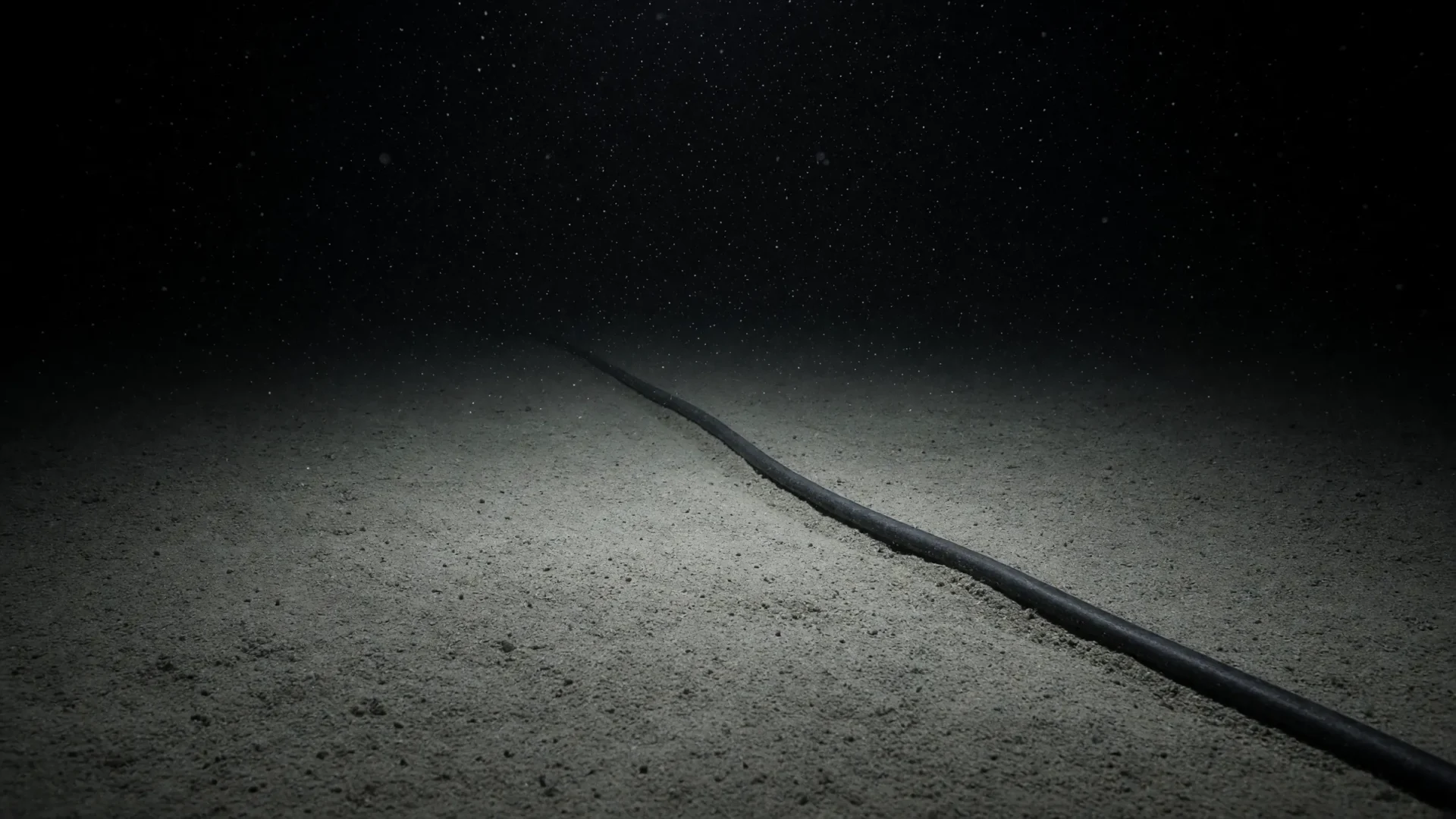
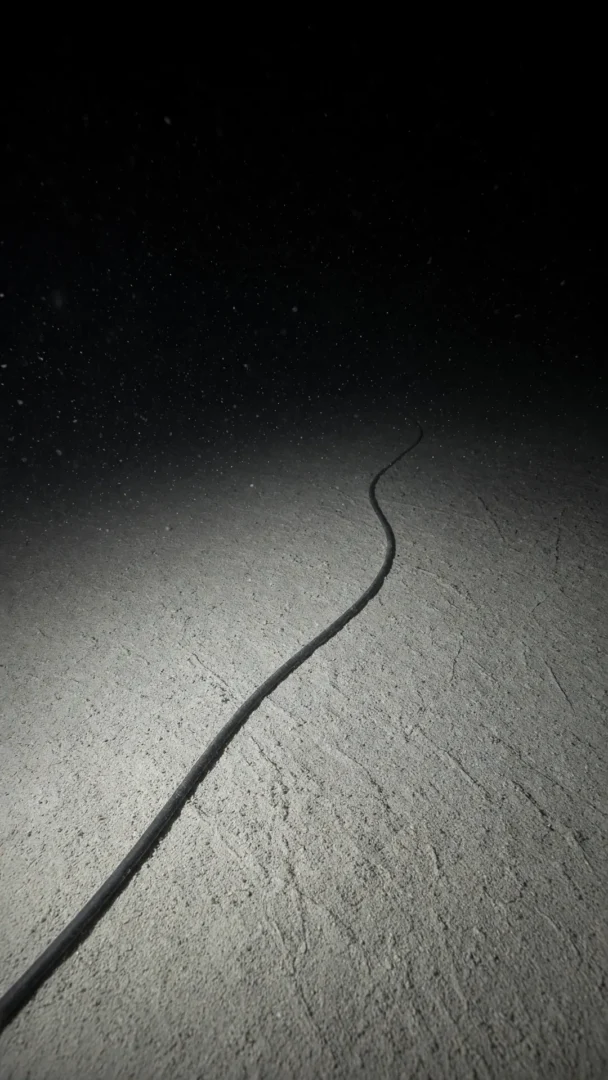
The abyssal plains lie 3,000–6,000 m down. Out here the cable is only 17–21 mm thick – the size of a garden hose – and it lies on the soft sediment in total darkness. In mid-Atlantic, Havfrue lies more than 4,000 m down.
20 mm The seabed
At this scale the cable on the bottom is a fiftieth of a pixel thick. If it were drawn one pixel wide, the water above it would be 225,000 pixels tall – about 60 metres of screen.
An illustration made with AI models, not the ship that laid Havfrue – which ship did that has not been published.
How it got there
An ocean of cable in one load
Cables are laid by ships built for it. SubCom, which built Havfrue, has six of one class: 139 metres long, with three tanks holding about 5,500 tonnes of cable – enough deep-sea cable for an ocean crossing. A fibre cable crosses the Atlantic in one or two voyages; in the analogue era it took four or five.
Once the cable reaches the bottom, the ship can lay at 11–15 km an hour, slowing down to pass each amplifier over the stern – about 200 km a day in deep water. The cable is paid out 2–3 per cent faster than the ship moves, so it lies slack and follows the seabed instead of hanging between the hills.
Inside the cable
Twelve threads of glass, wrapped for the deep
Most of the cable is not there for the light. The glass fibres sit in the middle, in gel inside a thin steel tube; everything around them is to keep them alive on the seabed for 25 years.
- The fibresThe main cable across the deep ocean carries six pairs – twelve fibres – designed for 108 terabits a second in all. Norway’s branch carries two pairs.
- Steel wiresStrength: the cable must survive being paid out from a ship and hauled up again for repair.
- CopperThe light fades, so every 70 km or so an amplifier boosts it. The power for them is fed from the shore down the copper, as direct current at up to about 15,000 volts.
- PolyethyleneInsulation against the sea. In shallow water, layers of steel armour wire go on the outside too.
When a cable breaks
Somewhere, a cable breaks about every two days
There are 150 to 200 cable faults a year around the world. Most are accidents in shallow water: accidents caused by people – mostly fishing gear and dragged anchors – cause 70–80 per cent. Sabotage is rare: under one per cent, says the industry’s International Cable Protection Committee.
The repair. A repair ship finds the fault, drags a grapnel along the seabed to hook the cable – or sends down a robot – and hauls both ends aboard. Joining the hair-thin fibres again and testing them can take 10 to 24 hours on its own. A typical repair takes one to two weeks.
What broke cables, 1959–2006
2,162 faults in the industry’s database
Tonga, 15 January 2022. The eruption of Hunga Tonga–Hunga Haʻapai sent debris racing along the seabed at up to 122 km an hour – the fastest such flows ever measured – and cut the island nation’s only international cable. Its service came back about five weeks later.
Then and now
From 98 words in 16 hours to 108 terabits a second
- The first cable across the Atlantic, Ireland to Newfoundland. Queen Victoria’s 98-word greeting takes about 16 hours to send. The cable fails after 26 days.
- The steamship Great Eastern lays a cable that lasts – 7 to 12 words a minute, sources differ.
- TAT-1, the first telephone cable: 36 calls at once, at $12 for the first three minutes.
- TAT-8, the first fibre-optic cable across an ocean: 40,000 calls at once.
- Havfrue: designed for 108 terabits a second – about 190,000 times TAT-8.
Norway’s cables to the world
Some of the data cables that come ashore in Norway, with lengths from TeleGeography’s database. Only Havfrue reaches another continent.
| Cable | Route | Length | In service |
|---|---|---|---|
| Havfrue (AEC-2) | Kristiansand – Denmark – Ireland – New Jersey | 7,650 km | 2020 |
| NO-UK | Stavanger – Newcastle | 713 km | 2021 |
| Norfest | Oslofjord – south coast – Stavanger – Sweden | 749 km | 2023 |
| Havsil | Kristiansand – Hanstholm, Denmark | 120 km | 2022 |
| Skagenfiber West | Larvik – Hirtshals, Denmark | 170 km | 2020 |
| Svalbard cables | Andøya – Longyearbyen, two cables | 2,714 km | 2004 |
| Arctic Way (planned) | Bodø – Jan Mayen – Longyearbyen | 2,568 km | 2028 |
The short answers
The internet under the sea in four numbers
Questions about undersea cables
How does the internet cross the ocean?
Through cables on the seabed. More than 99 per cent of the data that goes between continents travels as light in glass fibres inside submarine cables; satellites carry only a small share. In 2026 there are about 607 cable systems in service, together about 1.5 million km long.
How long does it take for data to cross the Atlantic?
Light in glass fibre travels at about 204,000 km a second, or 4.9 microseconds a kilometre. On the Havfrue cable, Kristiansand to New Jersey is about 7,000 km: about 35 milliseconds one way, about 70 there and back. Bulk, one of the owners, measures 72.5 ms there and back between New Jersey and Esbjerg in Denmark, including the equipment at each end. Everyday traffic is often slower, because it takes longer routes.
Which cable connects Norway to the United States?
Havfrue (also called AEC-2), in service since the end of 2020. Its main cable runs from Blaabjerg in Denmark to Wall Township, New Jersey, with branches to County Mayo in Ireland and to Kristiansand in Norway. It was built by Meta, Google, Aqua Comms and Bulk, and made by SubCom. The Norway branch is owned by Bulk and holds two fibre pairs. It is the only cable from Norway that reaches North America.
How thick is an undersea internet cable?
In the deep ocean, about 17–21 mm – the size of a garden hose. Near land, where it needs protection from trawls and anchors, layers of steel armour wire make it up to about 50 mm thick. The glass fibres inside are about as thick as a human hair: 125 micrometres of glass, 242 with their coating.
Are undersea cables buried?
Near land, yes: from the shore out to about 1,000–1,500 m depth, cables are usually ploughed about a metre into the seabed, out of reach of trawls and anchors. Deeper than that they are simply laid on the seabed.
How deep are undersea cables?
As deep as the sea they cross. On the abyssal plains of the Atlantic, 3,000–6,000 m down, they lie on the bottom; in mid-Atlantic Havfrue lies more than 4,000 m down. Repair ships have worked on cables more than 6,000 m deep.
How is the light kept strong over thousands of kilometres?
Every 70 km or so the cable has an amplifier: a length of glass with the element erbium in it, pumped by lasers, which boosts the light without turning it back into electricity. The power for them is sent from the shore down a copper layer in the cable, as direct current at up to about 15,000 volts.
How often do undersea cables break?
About 150 to 200 times a year worldwide – roughly one every two days. Most faults happen in water shallower than 200 m, and 70–80 per cent are accidents caused by people – mostly fishing gear and ship anchors. Earthquakes and undersea landslides cause fewer than one in ten.
How are undersea cables repaired?
A repair ship goes to the fault, hooks the cable with a grapnel dragged along the seabed – or uses an underwater robot – and lifts both ends aboard. A new piece of cable is spliced in; joining the fibres and testing them can take 10 to 24 hours. A typical repair takes one to two weeks.
Who owns the undersea cables?
Telecom companies, cable investors and, more and more, the big internet companies. Havfrue, for example, belongs to Meta, Google, Bulk Infrastructure and EXA Infrastructure (which took over Aqua Comms); Bulk alone owns the branch to Norway.
When was the first transatlantic cable?
In 1858, between Ireland and Newfoundland. Queen Victoria’s 98-word greeting took about 16 hours to send, and the cable failed after 26 days. The first one that lasted came in 1866. The first fibre-optic cable across the Atlantic, TAT-8, opened in 1988.
Sources
Researched and checked on 30 October 2026, from 49 sources; the main ones are below. Where sources disagree – the cable’s length, how far apart the amplifiers are, how many cables there are – we use the most recent figure from the primary source, and say so. Calculations (such as 35 milliseconds, 190,000 times or 37 times round the Equator) are ours.
- SubCom: “Consortium selects TE SubCom as supplier for HAVFRUE cable system” (9 January 2018); Google: “Expanding our global infrastructure with new regions and subsea cables” (16 January 2018)
- Bulk Infrastructure: Havfrue, Havsil and our systems; Submarine Networks: HAVFRUE/AEC-2
- TeleGeography: Submarine Cable Map (the Havfrue record, its route and every cable landing in Norway), “How Many Submarine Cables Are There, Anyway?” (23 September 2026), Submarine Cable FAQs, “Do Submarine Cables Account For Over 99% of Intercontinental Data Traffic?” and “Cable Breakage: When and How Cables Go Down”
- Carter and others (2009): “Submarine Cables and the Oceans: Connecting the World”, UNEP-WCMC/ICPC; Carter and Burnett (2015): “Subsea telecommunications”, Routledge Handbook of Ocean Resources and Management
- International Cable Protection Committee: media enquiries, FAQ and factsheet, “About Submarine Telecommunications Cables”; UNEP-WCMC and ICPC (2025): “Submarine cables and marine biodiversity”
- United Nations: World Ocean Assessment I, chapter 19, “Submarine Cables and Pipelines”; NOAA Ocean Exploration: abyssal plains; GEBCO: GEBCO 2020 Grid (depths along the route)
- Corning: SMF-28e+ optical fibre product information (speed of light in the fibre, sizes); The Physics Factbook: “Diameter of a Human Hair”
- Amplifier power: Krause Perin (2018), PhD thesis, Stanford, Spellman High Voltage, power feed equipment and Alcatel Submarine Networks, Ile de class vessels; SubCom: Reliance class vessel specifications; Nexans Norway: URC-1 light-weight submarine cable
- IEEE Spectrum: “The First Transatlantic Telegraph Cable Was a Bold, Beautiful Failure”; Engineering and Technology History Wiki: IEEE Milestone, TAT-8
- The Barents Observer: “Disruption at one of two undersea cables to Svalbard” and “‘Human activity’ behind Svalbard cable disruption” (2022)
- Physics Magazine: on Clare and others (2023), Science 381; APNIC Blog: “When volcanoes go bang, submarine cables do … what?” (Tonga, 2022)
- Space Norway and SubCom: “Arctic Way” (14 February 2025); ISPreview: NO-UK lands in the UK (26 July 2021); Orange: the cable ship Sophie Germain
Numbers we left out
- “The fibre is thinner than a hair” – the bare glass, 125 micrometres, is about as thick as a hair; with its coating it is thicker than most.
- Havfrue’s exact length – sources say 7,200, 7,622, 7,650 and 7,851 km. We say more than 7,500 km, and about 7,000 km from Kristiansand to New Jersey.
- Havfrue’s deepest point, its number of amplifiers and its voltage – not published. The depths and places on the crossing are read from a drawn route, not the real track.
- “99% of all internet traffic” – it is more than 99% of the traffic between continents, and even that can’t be measured precisely, says TeleGeography.
- The beach where the cable lands near Kristiansand – we couldn’t find it.
- Amplifiers “every 50 km” – sources give about 70 km, up to about 100.
- A cable from Norway to Canada – Bulk’s Leif Erikson cable is still a plan, without money to build it, as of October 2026.
- “The 1858 cable was laid by the Great Eastern” – an error in one industry brochure; it was laid by HMS Agamemnon and USS Niagara.
- How fast the 1866 cable was – sources say 7 and 12 words a minute; we give both.
- How much power Norway’s data centres use – we couldn’t check the figures against the regulator’s own report.
About the author. Pelle Nilsen, a developer in Norway and the maker of Midground, researched this story from 49 sources – the cable’s builders and owners, TeleGeography’s data, the International Cable Protection Committee, the UN and peer-reviewed research – and checked every figure on 30 October 2026.
Share it: midgroundwp.com/internet-cables · Cite it: Nilsen, P. (2026). “35 milliseconds to New York: how the internet crosses the ocean.” Midground. https://midgroundwp.com/internet-cables/
Spotted a mistake? Write to hello@midgroundwp.com and we’ll fix it.
Behind the page
How we made this page
This story is an ordinary WordPress page, built in Midground, a WordPress theme and visual builder for pages that move. The words, cards, questions and scroll effects are the builder’s own blocks; the drawings, the charts, a stylesheet for the page and a short script are our own code.
- The opening picture is an illustration, not a photo of Havfrue. We made it with an AI image model (Grok Imagine), set the marine snow drifting with an AI video model (Kling 3.0), and put it in a Depth group so it moves as you scroll. The cable ship is made the same way.
- The crossing is a Horizontal sequence with a 9,000-pixel drawing on a computer: about 7,000 km of cable, so 1.3 pixels a kilometre. The clock and the pulse of light, which move at the speed of light in glass, are part of our short script. The places along the way are read from TeleGeography’s drawn route, which shows roughly where the cable runs.
- The fall to the seabed is a section exactly 4,500 m tall – one pixel a metre on a computer, 0.85 on a tablet, 0.7 on a phone.
- The fibre and the cable are drawn to scale from the fibre maker’s data sheet and the industry’s own drawings.
- If you ask your device for less motion, the picture stays still, the film doesn’t play, and the crossing becomes a row you swipe.